
Samuel Press
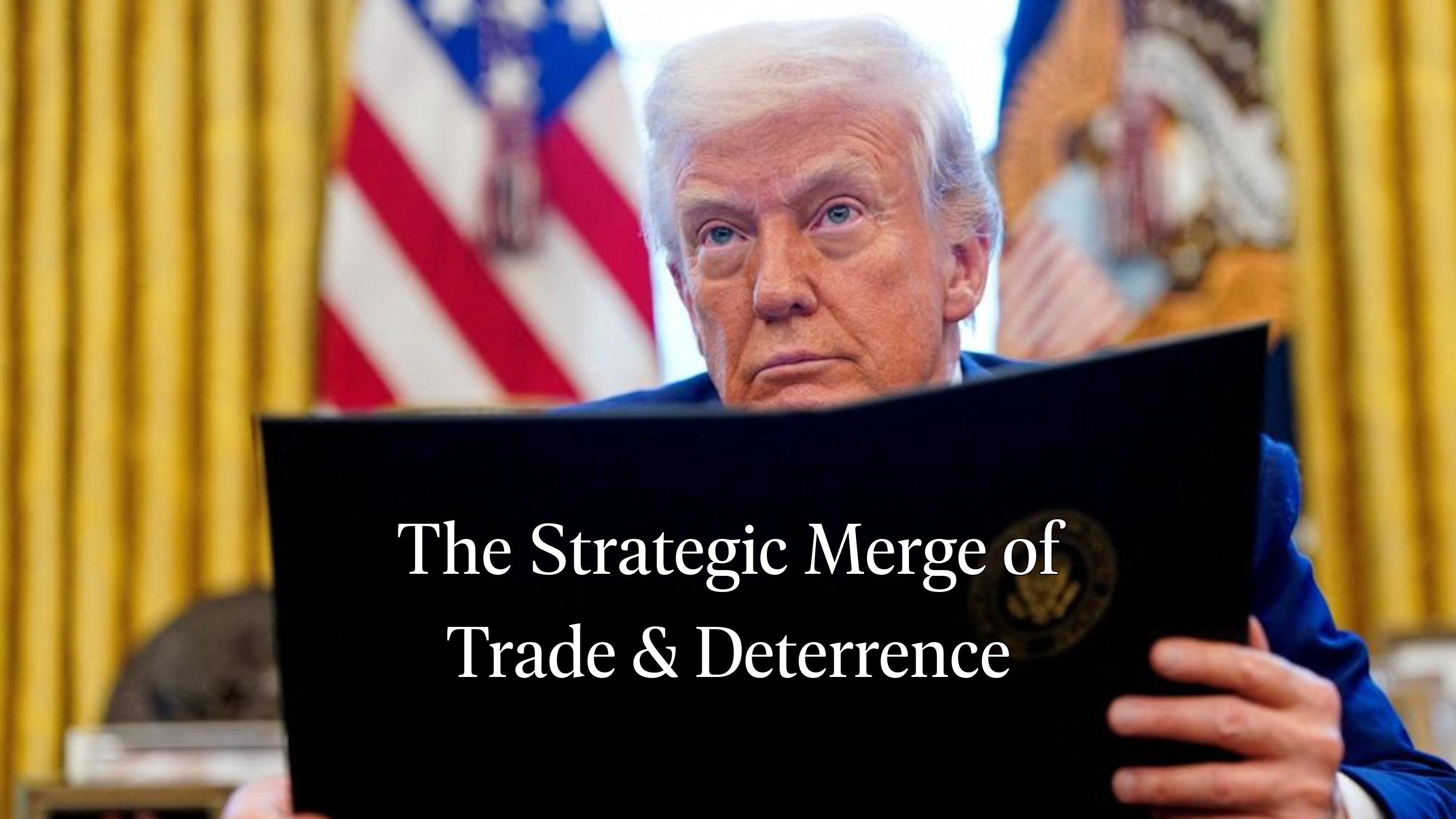
Standing on Pennsylvania Avenue today, it is clear that the classical divide between “economic development” and “strategic deterrence” is disappearing. Under President Donald J. Trump’s evolving doctrine of trade and alliances, the United States is moving toward a model where economic levers are integral to its security posture—and vice versa. Tariffs, alliance demands, and industrial realignment are no longer treated as separate tools of policy, but as interlocking components of national power.
Trump’s economic worldview deliberately collapses the traditional policy silos. In his approach, every bilateral economic relationship doubles as a strategic one. For instance, the administration’s 2025 declaration of a national emergency to impose reciprocity-based tariffs reframed America’s trade deficit as a matter of national security. From this perspective, global supply chains, market access, and industrial capacity are extensions of deterrence itself.
In this new reality, allies that run large trade surpluses with the United States while underinvesting in defense are seen as weakening—not strengthening—the alliance network. This marks a sharp departure from the postwar liberal order. Trade, in the Trump framework, is not a mutual good but a strategic instrument—a tool for coercion or reward depending on alignment with U.S. interests.
Deterrence in the 21st century extends far beyond missiles and bases. It now encompasses industrial strength, critical minerals access, and supply-chain resilience. Trump’s trade policy explicitly recognizes this. The tariff regime, coupled with an emphasis on domestic production and re-shoring, reflects the belief that America’s industrial base is a cornerstone of national defense.
While economists warn that tariffs can raise inflation and slow growth, the strategic argument is clear: a hollow industrial base erodes deterrence credibility. For Trump, rebuilding domestic manufacturing is not merely economic populism—it is a defense strategy. The message from Washington is unmistakable: industrial strength is defense; trade fairness is deterrence.
In this redefined landscape, alliances are being repriced. No longer are they sustained solely by shared values or legacy commitments. Instead, economic reciprocity, defense spending, and fair trade are the new metrics of strategic partnership.Allies that contribute more equitably to defense and maintain balanced trade relationships are rewarded with closer U.S. alignment. Those who benefit disproportionately from the American market while underfunding their militaries face new forms of pressure—from tariffs to diminished diplomatic favor.
This transactional approach to alliances reflects Trump’s view that global partnerships must serve both economic and security goals simultaneously. The U.S. is effectively using trade as a filtering mechanism: those who meet the threshold of reciprocity stay inside the strategic circle; those who do not are kept at arm’s length.
What emerges from this doctrine is a unified framework where economic leverage, industrial capacity, and defense posture reinforce one another. It represents an attempt to construct a new kind of deterrent architecture—one that rests as much on the machinery of production as on the machinery of war.
The potential benefits are significant. A strengthened industrial base enhances resilience and innovation. Conditional trade relationships can incentivize allies to share the defense burden. And by integrating economic and strategic tools, the United States can align its foreign and domestic priorities more coherently than at any time since the early Cold War.
The broader implication is profound: economic development and strategic return are becoming indistinguishable. The United States is no longer defining power through the dual lenses of “wealth” and “security.” Instead, it is reframing both as facets of the same objective—national advantage.
Yet this merging of trade and deterrence carries significant risks.
First, coercive trade measures may alienate key allies, weakening the very coalitions needed to counter rival powers. A strategy that views partners through purely transactional terms risks encouraging them to hedge or realign elsewhere.
Second, economic blowback could undercut domestic support. Tariffs that raise consumer costs or disrupt supply chains can test public patience with long-term industrial policy.
Third, over-transactionalism can hollow out the moral and institutional glue that has underpinned American alliances for decades. Shared values, legal interoperability, and trust cannot be replaced by cost-sharing formulas alone.
Finally, ambiguity about the broader grand strategy remains. Without a clear articulation of ultimate objectives—containment, decoupling, or competitive coexistence—both allies and adversaries may misread U.S. intent, amplifying instability.
For the trade-deterrence model to succeed, the U.S. must refine both message and execution. Clear signaling will be crucial so allies understand how trade behavior connects to strategic expectations. Tariffs must be coupled with robust investment in workforce training, infrastructure, and technological leadership.
Alliance management will require careful balance—recognizing that economic reciprocity cannot fully replace the intangible trust built through decades of cooperation. Flexibility will be essential as supply chains and political blocs shift. And above all, Washington must forge a coherent domestic narrative explaining that economic security is national security.
From Pennsylvania Avenue, the trend line is unmistakable. President Trump’s recalibration of trade and alliance policy marks a decisive shift toward an integrated model of deterrence. Economic policy is no longer a subset of prosperity—it is an instrument of power.
If managed with discipline, this fusion could deliver a formidable strategic advantage: one in which American industrial capacity, technological innovation, and alliance leverage operate as a single system of deterrence. But if handled carelessly, it could produce fragmentation—alienating allies, distorting markets, and eroding the very foundations of the liberal order it seeks to replace.
In this new era, America’s challenge is not whether it can lead—it is whether it can align its economic might and strategic vision into a coherent grand strategy. The future of deterrence may well depend on it.
